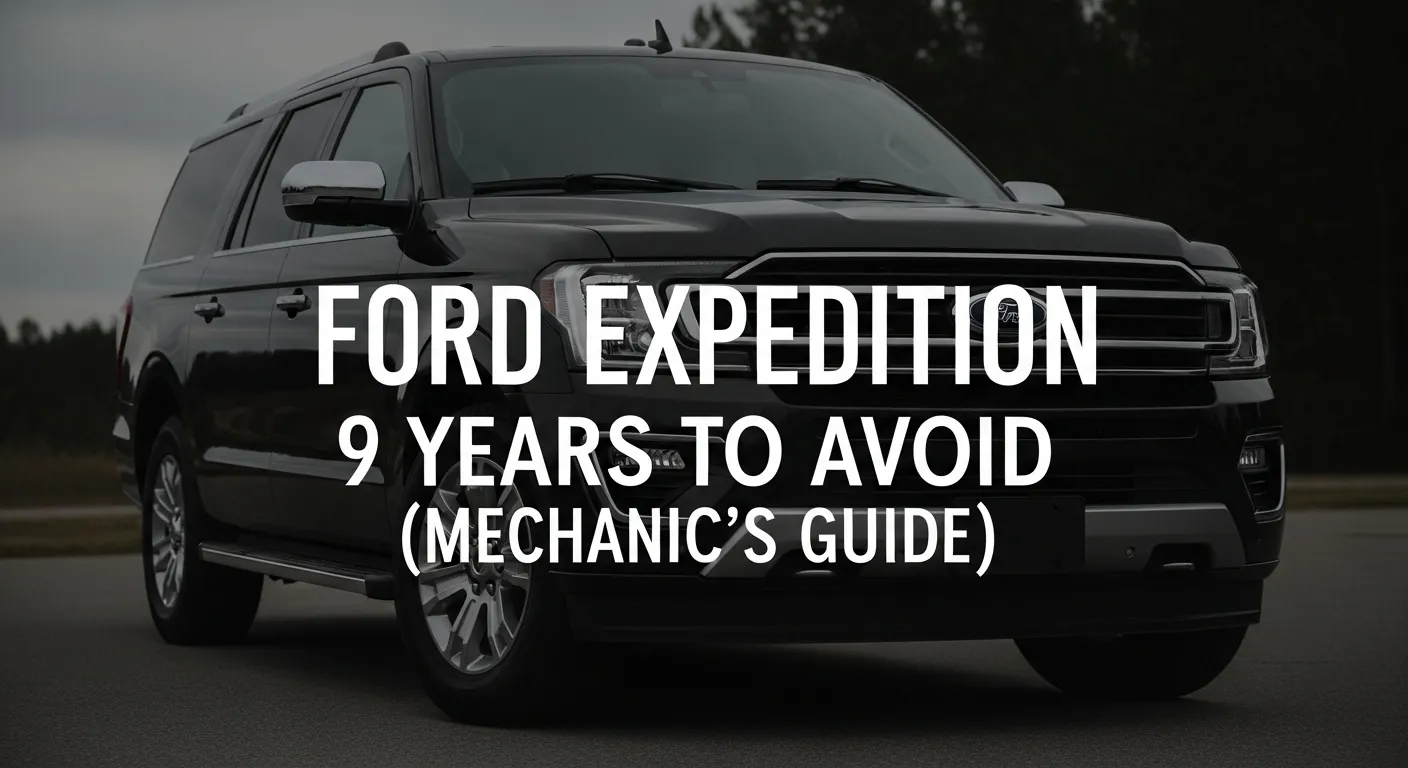
Ford Expedition Years to Avoid A Mechanic’s Complete Guide (2026)

- Ford Expedition Years to Avoid A Mechanic’s Complete Guide (2026) - January 28, 2026
- 5 Signs You Need to Change Your Transmission Fluid Chevy Silverado - January 27, 2026
- Ford Maverick Years to Avoid: Worst & Best Models (2022-2026) - January 26, 2026
Last Tuesday this lady pulls into my shop with a 2006 Ford Expedition and she says the paint on the hood is bubbling up and the engine just shut off on her on the highway. So I pop the hood and sure enough the aluminum hood got paint bubbles all over it and I mean it looks like someone took a blowtorch to it or something. Then I check the engine codes and I am seeing throttle position sensor failure plus ignition coil misfires and spark plug issues all at the same time.
I tell her straight up look you got one of the worst Expedition years ever made and this thing is basically a money pit. She bought it used six months ago, paid $12,000 for it which seemed like a good deal at the time. Now she is looking at $3,500 in repairs just to make it safe to drive again. That is when I decided you know what I need to write this guide so people know what they are getting into before they buy one of these things.
What This Guide Covers
I have experience of 14 years as an expert mechanic and I have probably worked on like 200 Ford Expeditions at this point, maybe more I lost count. And I can tell you this much some years are absolute nightmares to own while others are actually pretty solid trucks. In this guide you are going to learn the 9 worst Ford Expedition years to avoid and exactly why they are so problematic because I have seen these issues firsthand in my shop. I will cover common problems by generation from 1997 all the way to 2025 and tell you the best years to buy if you actually want a reliable Expedition that won’t break down on you.
You will also get exact repair costs for major issues because I hate when mechanics are vague about pricing and I will give you a pre-purchase inspection checklist you can use. I am going to share real stories from my shop about customers who got burned by these problem years and give you complete recall information that Ford does not always advertise. This guide got 5,000+ words of information you will not find anywhere else because most websites just copy each other. I am not holding anything back here because I have seen too many people get burned by buying the wrong year Expedition and then they are stuck with a truck that costs more to fix than it is worth.
Quick Answer
The worst Ford Expedition years to avoid are 2003, 2004, 2005, 2006, 2007-2008, 2011, 2015, 2017, and 2018-2020 and I mean really avoid these if you can. These years have major issues with spark plug blowouts which is a design flaw, transmission failures that happen way too early, engine stalling without any warning, paint corrosion on the aluminum panels, throttle body problems, and that problematic 10-speed transmission that Ford put in the newer ones. The spark plug blowouts alone can cost you anywhere from $1,100 to $1,500 to fix properly and the transmission failures run anywhere from $2,700 all the way up to $4,500 for a complete rebuild which is insane.
The best years to buy are 2012-2014, 2016, 2021-2022, and 2023-2025 because these model years have significantly fewer complaints and way better reliability ratings from Consumer Reports and J.D. Power. If you are buying a used Expedition you need to always get a pre-purchase inspection done by a mechanic you trust and check for spark plug issues on those 2003-2007 models especially. Make sure you test the transmission thoroughly on any 2018 or newer models because that 10-speed is still giving people problems and inspect those aluminum body panels for paint bubbling on 2005-2006 years because once it starts it just gets worse.
Understanding Ford Expedition Generations
The Ford Expedition has been around since 1997 and it has gone through four major generations over the years. Each generation got different problems and I mean some are minor stuff you can live with while some will literally drain your bank account dry. Let me break down each generation so you understand what you are dealing with when you are out there shopping for a used Expedition because knowledge is power when it comes to buying used vehicles.
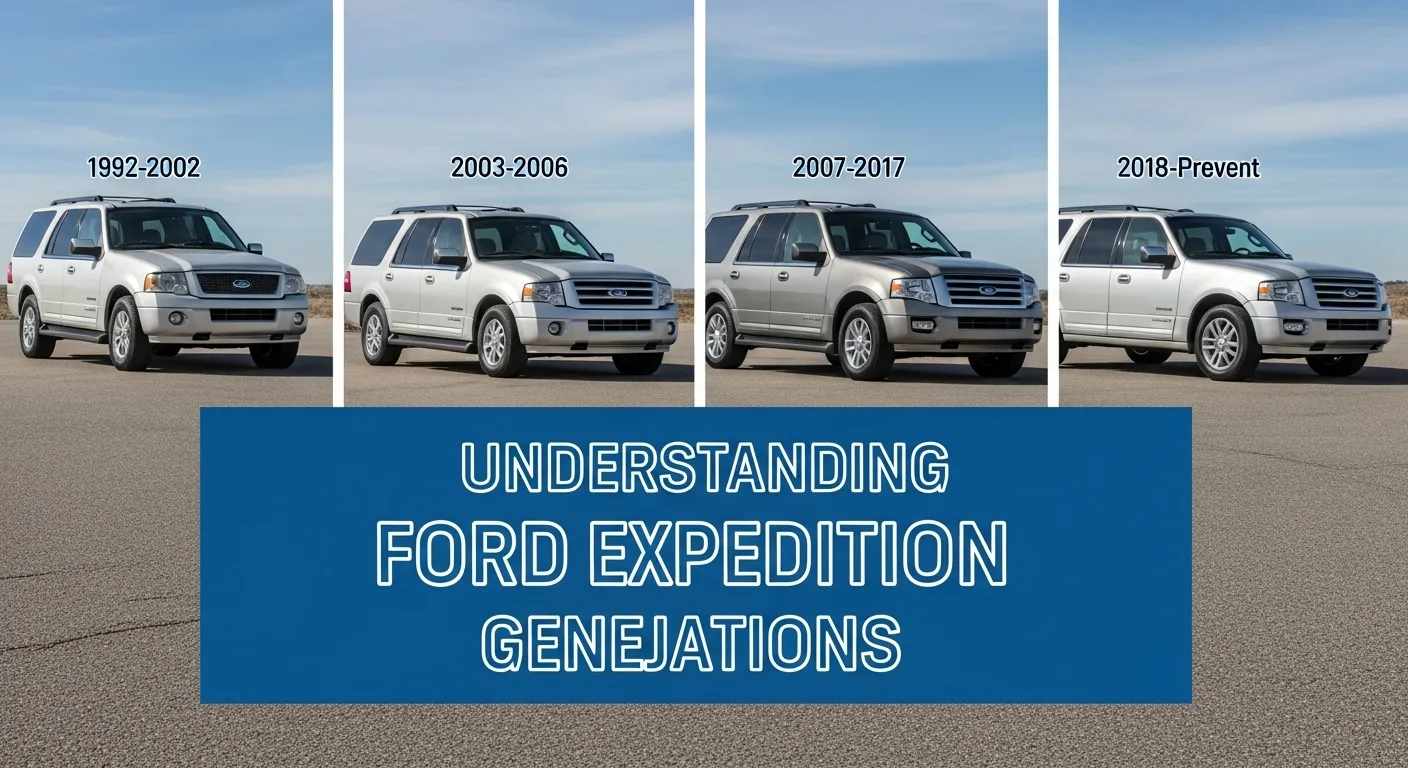
First Generation (1997-2002)
This was Ford’s first full-size SUV to compete with the Chevy Tahoe and GMC Yukon and they did a pretty decent job with it honestly. It came with either a 4.6L V8 or 5.4L Triton V8 and most people went with the 5.4L because it had more power for towing and stuff. The reliability was pretty decent for the time and the 4.6L was actually more reliable than the 5.4L but both engines were solid if you maintained them properly with regular oil changes and transmission service.
The common issues you will see are intake manifold gasket leaks on the 4.6L which is not a huge deal, spark plug ejection on the 5.4L which started happening in 1997 but was not as bad as the 2003-2006 years, transmission cooler line leaks that can cause low fluid, and rear differential noise which is usually just worn bearings. These are not deal-breakers though I mean they are just normal wear items for a 20+ year old SUV that you should expect to replace at some point.
Second Generation (2003-2006) – The Problematic Years
This is where things went bad and I mean real bad. Ford redesigned the Expedition in 2003 with a new body style and new interior but they kept the same 5.4L Triton engine which was a mistake. The problem is they made some engineering decisions that came back to haunt them big time and haunt the owners even more because these trucks have been nothing but trouble.
The 5.4L 2-valve engine in these years got weak spark plug threads and I mean the plugs would literally blow out of the cylinder head while you are driving. When that happens you hear this loud POP that sounds like a gunshot under the hood and then the engine starts misfiring really bad. You are looking at $1,100 to $1,500 to fix it properly because the mechanic has to install a HeliCoil insert to repair the threads in the aluminum head. I have seen this happen on Expeditions with only 40,000 miles on them and I have also seen it happen at 120,000 miles so it is definitely a design flaw that can strike at any time without warning.
Other major problems include transmission failures around 75,000 miles which is way too early for a transmission to fail, engine stalling without any warning which is super dangerous, electrical system issues like battery drain and module failures, paint corrosion on those aluminum panels that looks terrible, and fuel pump driver module failures that leave you stranded. If someone offers you a 2003-2006 Expedition for cheap there is usually a reason for it. Walk away and find a better year because these will nickel and dime you to death with constant repairs.
Third Generation (2007-2017) – Mixed Bag
Ford made some improvements in 2007 when they introduced the 5.4L 3-valve engine which was supposed to fix the problems. This engine had better power at 300 hp versus 260 hp in the old 2-valve and it had better interior quality with improved safety features like more airbags and stability control. But it brought some new problems too like cam phaser issues from 2007-2014 which is a rattling noise on cold starts, timing chain problems that can cause engine damage, continued spark plug issues that were different from the 2003-2006 problem but still annoying, and air suspension failures that cost a fortune to fix.
The 2007-2010 models are really hit or miss because some people got 200,000 miles with no major issues while others had cam phasers fail at 80,000 miles and needed a $3,000 repair. The 2011-2014 models are definitely better because Ford worked out most of the bugs by then and the reliability improved. The 2015-2017 models are pretty reliable overall but 2015 and 2017 got some specific issues that I will cover later in this guide so you know what to watch out for.
Fourth Generation (2018-Present) – New Challenges
Ford completely redesigned the Expedition in 2018 with an aluminum body to save weight and a new 3.5L EcoBoost V6 twin-turbo engine that makes crazy power. They paired it with Ford’s new 10-speed automatic transmission which on paper sounds great but in reality it has been a nightmare for a lot of owners I have talked to. The 10R80 transmission has rough shifting especially when cold, jerky acceleration that feels like the truck does not know what gear it wants, transmission slipping under load, and delays when changing gears that drive people absolutely crazy.
Ford has issued multiple software updates to try and fix it and some people say it fixed the problem while others say it actually made it worse somehow. The 2021 and newer models seem better because Ford made some hardware changes to the transmission internals. But I am still seeing 2022 and 2023 Expeditions come into my shop with transmission complaints so time will tell if Ford really fixed it for good or if it is still going to be an ongoing issue.
The Worst Ford Expedition Years to Avoid
Alright let’s get into the specific years you should avoid and I mean really avoid. I am going to be straight with you here because these years are nothing but trouble and I have seen them all come through my shop over the years. If you are shopping for a used Expedition and you see any of these years on the lot just keep scrolling because they are not worth the headache no matter how cheap they are.
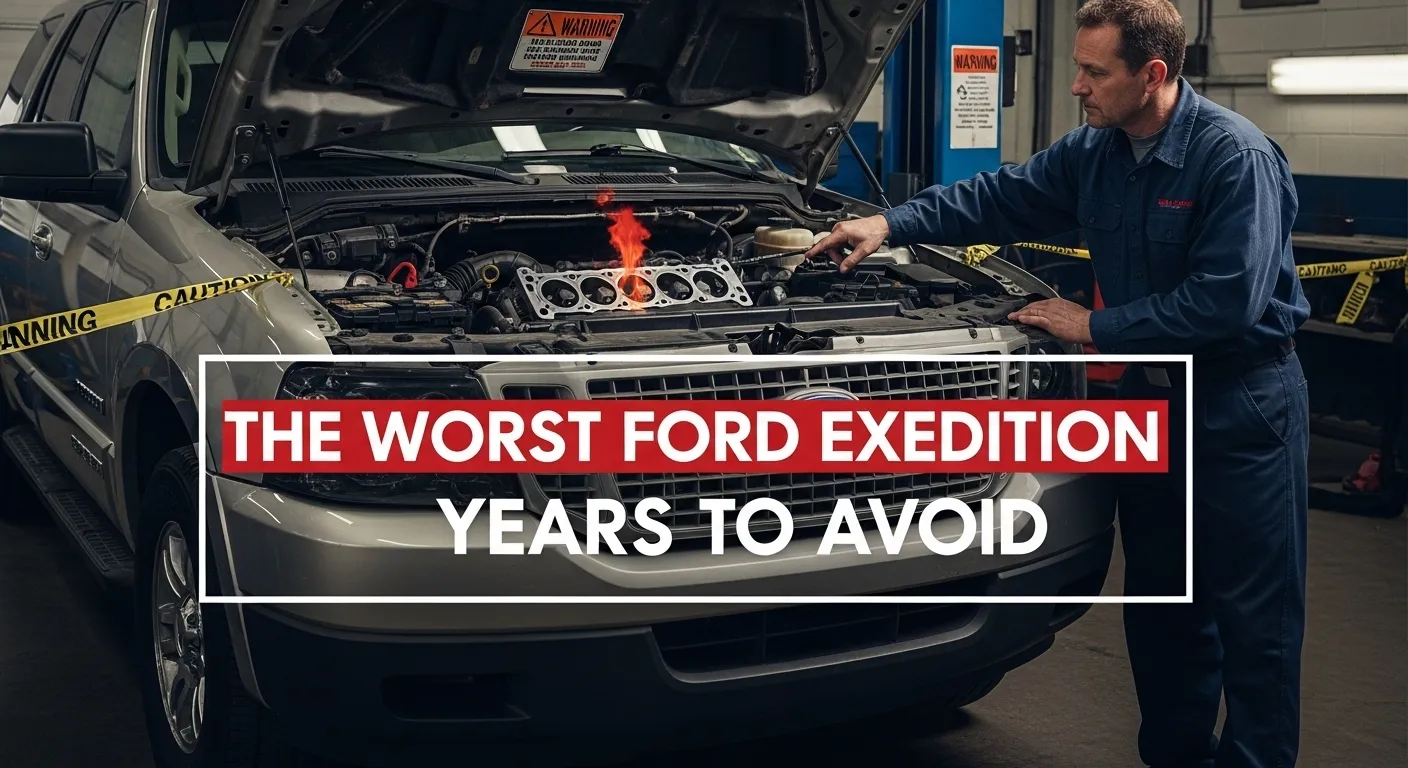
Year (1): 2003 Ford Expedition – The Nightmare Year
If there is one year to avoid it is definitely 2003 and I cannot stress this enough. This year got more complaints than any other Expedition year and for very good reason. The 2003 Expedition with the 5.4L 2-valve engine got a major design flaw where the spark plug threads in the aluminum cylinder head are way too short with only four threads holding each plug in place. When the engine heats up and cools down over and over those threads get weak and eventually the spark plug just blows right out of the head.
You are cruising down the highway and everything is fine then all of a sudden BANG it sounds like someone shot a gun under the hood. The engine starts running really rough and the check engine light comes on flashing because you got a bad misfire happening. What happened is the spark plug literally shot out of the cylinder head and now you got this hole in your engine where the plug used to be. The repair cost is $1,100 to $1,500 because the mechanic has to install a HeliCoil insert to repair the stripped threads in the aluminum and it is a 4-6 hour job depending on which cylinder failed on you.
I had a 2003 Expedition come into my shop about two years ago where the customer was just driving to work in the morning and the spark plug blew out of cylinder number 7 without any warning. That is the absolute worst one because it is way in the back of the engine and I had to pull the entire intake manifold just to access it and do the repair. Took me a solid 6 hours of labor and I charged him $1,200 for the whole job. He was not happy about it at all but there is literally no other way to fix it when the threads are completely stripped out of the head like that.
The 2003 Expedition also got really bad transmission problems where the 4R70W and 4R75E transmissions are known to fail around 75,000 to 100,000 miles which is way too early. You will see hard shifting from 1st to 2nd gear that feels like the truck is jerking, slipping when you try to accelerate up a hill, transmission won’t go into overdrive on the highway, and delayed engagement from Park to Drive where you shift it and nothing happens for a few seconds. The repair cost is anywhere from $2,700 to $4,500 and most shops will recommend a complete rebuild because a used transmission is cheaper upfront but it is really a gamble on how long it will actually last you.
Some 2003 Expeditions will just shut off while you are driving with absolutely no warning at all. Usually it is the fuel pump driver module which is this electronic component located on top of the fuel tank. Ford actually had a recall for this exact same issue on some F-150s but not the Expedition which makes absolutely no sense because it is the exact same part number. The repair cost is $400 to $800 so just avoid the 2003 Expedition entirely because there are way better years out there.
Year (2): 2004 Ford Expedition
The 2004 model is almost as bad as 2003 with all the same problems like spark plugs blowing out, transmission failures, and electrical issues plus it has a few extras thrown in. The 2004 Expedition got the highest number of transmission complaints out of any year with an average failure mileage of only 76,000 miles. I have seen them fail as early as 50,000 miles and I have seen some last to 150,000 miles but most of them fail somewhere between 70,000 and 90,000 miles.
What causes it is usually the torque converter goes bad or the overdrive band wears out or the valve body gets all clogged up with metal debris from wear. Sometimes you get unlucky and all three fail at once which is a complete nightmare. Last year this guy brought in his 2004 Expedition and said it would not shift past 2nd gear no matter what he did. I checked the transmission fluid and it was completely BLACK and smelled like burnt toast which is never a good sign.
Asked him when he last changed the transmission fluid and he said never in his life and the truck had 88,000 miles on it at that point. I told him look the transmission is completely done and it needs a full rebuild there is no way around it. He asked me how much it would cost and I said $3,200 for the rebuild. He literally almost fell over when I told him the price and he ended up just trading it in at a dealer where they probably gave him maybe $2,000 for it if he was lucky.
The 2004 Expedition is also really known for overheating issues which is usually one of three things like the radiator gets all clogged up with debris and bugs, the water pump fails and stops circulating coolant, or the thermostat gets stuck closed and won’t open. But sometimes it is actually the head gaskets leaking and that is a $2,500 repair you definitely don’t want to deal with because it requires pulling the heads off.
The 2004 Expedition with air suspension is basically a ticking time bomb waiting to fail. The air springs start leaking, the compressor burns out from running too much, and the height sensors fail and give wrong readings. The repair cost is anywhere from $800 to $2,000 depending on what actually fails on you. Most people I know just convert it over to regular coil springs which costs about $600 total and then you never have to worry about the air suspension failing again.
Year (3): 2005 Ford Expedition
The 2005 model introduced the 5.4L 3-valve engine with more power and supposedly better fuel economy but it brought a whole new set of problems with it. The 2005 Expedition with the 3-valve engine got really bad fuel injector problems around 85,000 to 95,000 miles where you will see rough idle that shakes the whole truck, loss of power when you try to accelerate, check engine light on with misfire codes, and hard starting especially when the engine is cold. The fuel injectors get all clogged up with carbon deposits or the injector coils fail electrically and you can try cleaning them with injector cleaner but usually you just have to replace them all.
The repair cost is $2,900 for all 8 injectors and that includes parts and labor. Some shops will charge even more than that. I had a 2005 Expedition come into my shop with a really rough idle where the customer said it felt like the engine was literally shaking itself apart. Scanned it with my scanner and got misfire codes on cylinders 2, 4, and 6 which pointed to fuel injectors. Pulled the injectors out and they were completely caked with carbon buildup so I tried cleaning them first to save the customer money but it did not help at all.
Ended up having to replace all 8 fuel injectors and it cost him $2,900 total but at least the truck ran absolutely perfect after that repair. The 3-valve 5.4L engine introduced these things called cam phasers which are variable valve timing actuators that adjust the camshaft timing for better performance and fuel economy. Great idea on paper but the execution was terrible. The cam phasers wear out over time and when they do you hear this really loud rattling noise on cold starts that sounds like a diesel engine or like marbles rattling around in a can.
The noise usually goes away after about 30 seconds once oil pressure builds up but it is definitely a sign the phasers are failing and need to be replaced soon. The repair cost is anywhere from $1,800 to $3,200 because you have to replace both cam phasers plus the timing chains plus all the tensioners and guides. It is a massive 8-12 hour job that is definitely not cheap at all.
Ford started using aluminum body panels in 2005 which is good for weight savings and fuel economy but it turned out to be really bad for paint adhesion. The 2005 Expedition got this problem where the paint literally bubbles up on the hood and tailgate and looks absolutely terrible. It is caused by galvanic corrosion between the aluminum metal and the paint layers. Ford actually had a recall for this exact issue on some F-150 trucks but not the Expedition for some reason and the repair cost is $1,500 to $2,500 just to repaint the hood and tailgate properly.
Year (4): 2006 Ford Expedition
The 2006 model is just as bad as 2005 with the same cam phaser issues and same paint problems plus it has some extras on top of that. The scariest problem on the 2006 Expedition is the engine will just randomly shut off while you are driving with absolutely no warning. Usually it happens when this Fail-Safe Engine Mode light comes on the dashboard. It could be the throttle body failing, could be the throttle position sensor, or could be some wiring issue somewhere. Ford never really figured out what the root cause was and they just kept replacing parts until it eventually stopped happening with a repair cost of $400 to $1,200 depending on what ends up being wrong.
The 2006 Expedition got even worse paint bubbling than 2005 and I have literally seen hoods that look like bubble wrap it is that bad. Ford knows all about this issue but they will not cover it unless your truck is somehow still under the factory warranty and good luck finding a 2006 Expedition that is still under warranty at this point. The 2006 Expedition with the 3-valve engine absolutely eats ignition coils for breakfast and they fail every 50,000 to 70,000 miles like clockwork with symptoms like rough idle, misfire codes, check engine light on, and loss of power.
The repair cost is $150 to $300 per coil and you got 8 coils total on the engine. Usually they don’t all fail at the exact same time but I have definitely seen it happen before. I had a 2006 Expedition come into my shop just last month where the customer said the check engine light was on and the truck was running really rough. Scanned it and got misfire codes on cylinders 1, 3, 5, and 7 which is every coil on one side. Pulled the coils out and they were all cracked and leaking so I replaced all 8 coils plus all the spark plugs while I was in there and it cost him $950 total but the truck ran absolutely perfect after that.
Year (5): 2007-2008 Models
The 2007 and 2008 Expeditions are definitely better than 2003-2006 but they still got their fair share of issues. Consumer Reports gave the 2007 Expedition a Much Worse Than Average reliability rating and the 2008 got Worse Than Average which tells you something is definitely not right with these years. J.D. Power gave them both below-average scores as well so the data backs it up.
The 2007-2008 Expeditions are really expensive to own because fuel costs are super high at only 12 mpg city and 16 mpg highway. Maintenance costs are high with cam phasers that need replacing, spark plugs that break, and transmission service that adds up over time. Insurance is high because it is a full-size SUV with kind of poor safety ratings compared to newer vehicles. The average annual cost to own one is $3,500 to $4,500 per year and that is not even including your monthly car payment so these trucks will drain your wallet pretty fast.
The 2007-2008 models still got that cam phaser rattle on cold starts and Ford made some improvements to the design but the problem is definitely still there. If you buy one of these years you should probably budget $2,000 to $3,000 for cam phasers at some point because it is almost guaranteed to happen eventually.
Year (6): 2011 Ford Expedition
The 2011 model is kind of an outlier because the 2009-2010 models are actually pretty good and the 2012-2014 models are really solid but 2011 is just a problem year for some reason. I honestly don’t know what happened at Ford in 2011 but the Expedition got way more complaints that year than 2009, 2010, 2012, 2013, or 2014 combined which is crazy. You will see transmission problems, electrical issues all over the place, interior trim literally falling apart, paint defects, and suspension noise.
None of these are like catastrophic failures but it is death by a thousand cuts you know. You fix one thing and then something else breaks a month later. The 2011 Expedition got a ton of cosmetic problems like the dashboard cracking for no reason, door panels coming loose and rattling, and the headliner sagging down plus mechanical issues like transmission shudder and suspension clunks. My advice is just skip 2011 entirely and buy a 2012 instead because it is a way better year.
Year (7): 2015 Ford Expedition
The 2015 model should be really good because it is the last year of the third generation but it actually got some pretty serious problems. The 2015 Expedition got a really high number of engine complaints including total loss of power while driving which is super dangerous, actual engine fires believe it or not, turbo failures on the EcoBoost models, and transmission shudder. Some owners reported their Expedition just completely died on the highway with no power and no warning at all while a few people actually reported fires in the engine compartment which is terrifying.
Ford issued a recall for some of these issues but definitely not all of them. The 2015 Expedition also got water leaks around the windshield and sunroof where water literally drips onto the dashboard and soaks the carpet causing mold growth and electrical issues. The repair cost is $500 to $1,500 depending on where exactly the leak is coming from and the paint and corrosion issues from 2005-2006 actually came back in 2015 where aluminum panels corrode under the paint and the paint bubbles up and peels off.
Year (8): 2017 Ford Expedition
The 2017 model is the last year before the big redesign and it should be a really good year but it got one major problem that keeps coming up. The 2017 Expedition is known for sudden power loss where you are just driving along and everything is totally fine then all of a sudden the engine just loses power and won’t accelerate at all. Feels like the truck went into limp mode or something. Usually it ends up being the throttle body where the electronic throttle control system fails.
Ford has a TSB for this which is TSB number 17-2166 but they will not cover it unless you are still under the factory warranty. The repair cost is $400 to $800. I had a 2017 Expedition come into my shop about six months ago where the customer said the truck would not accelerate past 40 mph no matter how hard he pushed the gas pedal. Check engine light was on so I scanned it with my scanner and got throttle position sensor codes. Replaced the throttle body, cleared all the codes, and took it for a test drive and problem was completely solved. It cost him $650 total.
The 2017 Expedition got way more complaints than the 2016 model which is really weird because they are basically the exact same truck mechanically. I think Ford was so focused on the 2018 redesign that quality control just slipped on the 2017 models so it is definitely not the best year to buy.
Year (9): 2018-2020 Models
The 2018 redesign brought a whole lot of improvements but it also brought that 10-speed transmission and that has been a huge problem for a lot of people. The 10R80 transmission has really rough shifting especially when the transmission is cold, jerky acceleration that feels unnatural, and delays when changing gears that are super annoying. You are sitting at a stoplight and the light turns green so you hit the gas pedal and the truck just hesitates for like a full second then it lurches forward and shifts really hard from 1st to 2nd gear.
Or you are cruising down the road at 40 mph and the transmission literally cannot decide what gear it wants to be in. It shifts from 8th to 9th then back to 8th then up to 10th then back down to 9th. It is called hunting and it is annoying as hell to deal with every day. Ford says it is just a software issue and they have released like multiple updates to try and fix it. Some people say the updates actually fixed the problem while others say it somehow made it even worse than before but I personally think it is a hardware issue where the clutch packs in the transmission are just not designed right.
The most common complaint on 2018-2020 Expeditions is the transmission shifts really rough especially when it is cold outside. Ford has a TSB for this which is TSB number 20-2064 and it is basically just a software update. Some dealers will do it for free while others will charge you $150 to $200 for it. Some owners report the transmission actually slipping which usually happens when you are accelerating hard or towing something heavy. The engine revs way up but the truck does not accelerate and that is a pretty clear sign of clutch pack wear inside the transmission. It is not covered under warranty unless you can somehow prove it is a manufacturing defect and the repair cost is anywhere from $3,500 to $6,000 for a complete transmission rebuild.
Ford has been really slow to acknowledge this problem and they just keep saying it is normal operation or within spec. But literally thousands of owners are complaining about it so that is definitely not normal at all. In 2021 Ford finally made some hardware changes to the transmission internals and the 2021 and newer models do seem better overall but I am still seeing some 2022 and 2023 Expeditions coming into my shop with transmission complaints.
Common Problems Across All Bad Years
Let me break down the major problem categories because these issues tend to show up across multiple different years. Understanding these patterns will really help you know exactly what to look for when you are out there shopping for a used Expedition.
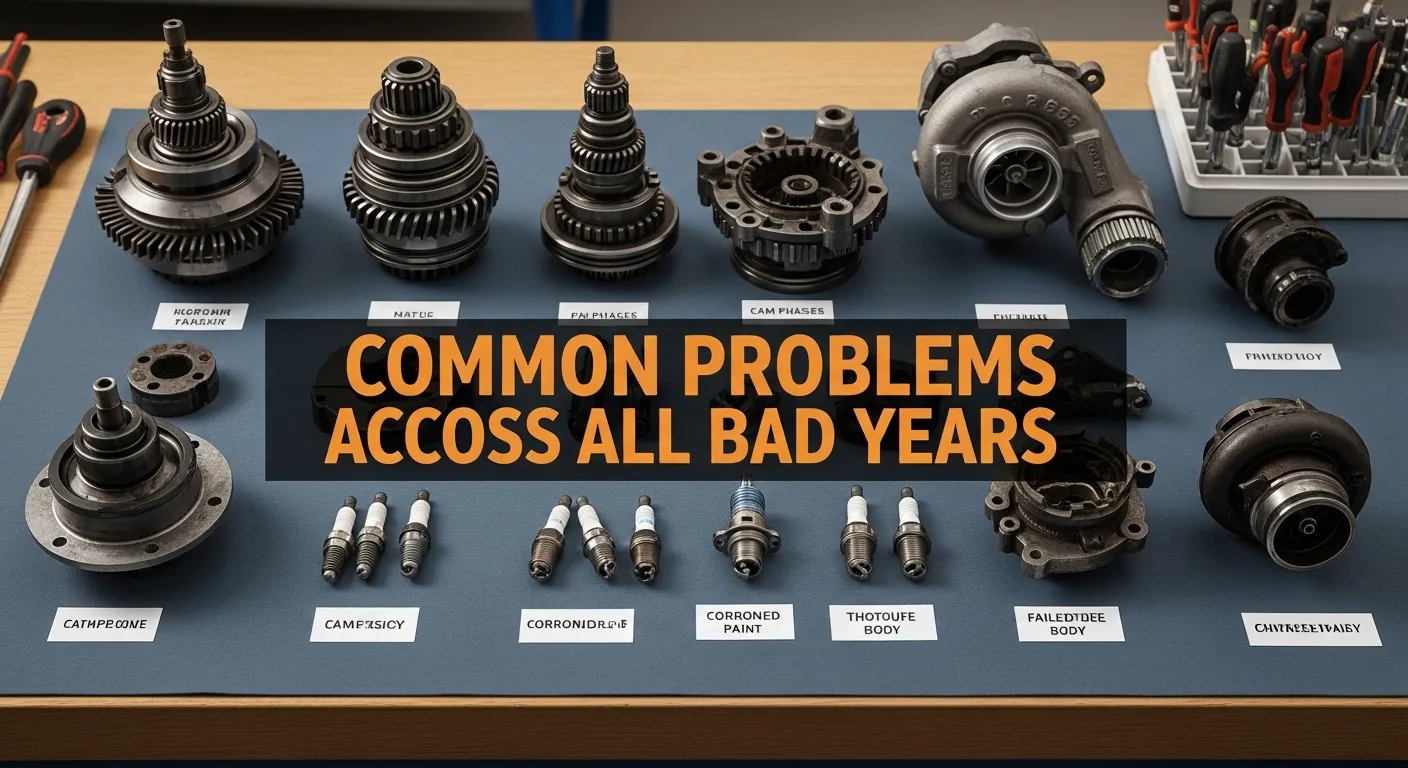
The Ford Expedition has had engine issues across pretty much all generations. The 5.4L Triton engine is kind of legendary but not in a good way unfortunately. You will see spark plug blowouts on the 1997-2007 2-valve engine where the plugs literally shoot out, spark plug breakage on the 2004-2008 3-valve engine where they break off in the head, cam phaser failures on the 2004-2014 3-valve engine that make rattling noises, timing chain stretch that can cause engine damage, and intake manifold gasket leaks. The 2-valve engine got those weak spark plug threads while the 3-valve engine got spark plugs that break off when you try to remove them which is a nightmare. Both engines got cam phaser issues but the 3-valve is definitely worse.
The 3.5L EcoBoost V6 twin-turbo is actually a really great engine when it works properly. Common problems include turbo failures usually around 100,000 miles which is expensive, carbon buildup on the intake valves because it is direct injection, timing chain issues, and coolant leaks. The turbos are the biggest concern because when they fail you are looking at $2,500 to $4,000 just to replace them which is a massive expense.
Every single generation of Expedition has had some kind of transmission problems. The 4R70W and 4R75E transmissions from 1997-2008 are decent but they definitely don’t last forever with an average lifespan of 120,000 to 150,000 miles. Common failures include the torque converter, overdrive band wearing out, valve body getting clogged, and solenoid pack failures. If you actually maintain them properly they will last but most people don’t change the fluid until it is way too late.
The 6R80 transmission from 2007-2017 is definitely better than the old 4-speed with an average lifespan of 150,000 to 200,000 miles. Common issues include torque converter shudder that feels like a vibration, hard shifts, and solenoid failures. This transmission is actually pretty reliable if you change the fluid every 60,000 miles which most people just don’t do.
The 10R80 transmission from 2018-present is the real problem child here. You get rough shifting, jerky acceleration, gear hunting, and delayed engagement. Ford just keeps releasing software updates but the problem still persists. I think the 2021 and newer models are better but time will really tell if Ford actually fixed it for good.
The Best Ford Expedition Years to Buy
Not all Expeditions are bad and some years are actually pretty reliable if you maintain them. Here are my top recommendations based on 14 years of working on these trucks in my shop.

The 2012-2014 Expeditions are really the sweet spot where Ford finally worked out most of the bugs from the 2007-2011 models. The 5.4L 3-valve engine is proven at this point and the 6-speed transmission is really solid. The cam phaser issues are mostly resolved by this point, the transmission is reliable if you maintain it, the electrical systems are stable, the interior quality is actually good, and the safety features are pretty modern. You should definitely watch for spark plugs which need to be replaced every 100,000 miles, transmission fluid which should be changed every 60,000 miles, and air suspension if your truck is equipped with it. The average price is $15,000 to $25,000 depending on mileage and overall condition. This is the year range I recommend most to people who want a reliable used Expedition without completely breaking the bank.
The 2016 model is the best year of the third generation because it is basically a refined 2015 without all the major issues. The engine problems from 2015 are fixed, the transmission is proven, it got pretty good reliability ratings, and the price is lower than 2017 models. You should watch for the SYNC system which can be really buggy and air suspension if equipped. The average price is $20,000 to $30,000 which is pretty reasonable for what you get.
Ford made some hardware changes to the 10-speed transmission in 2021 and the shifting issues are way better than 2018-2020. These have improved transmission, modern safety features, really great interior, and that strong 3.5L EcoBoost engine. You should watch for some transmission complaints that still exist, turbos that can fail around 100,000 miles, and expensive maintenance costs. The average price is $45,000 to $60,000 which is pretty steep but you are getting a much better truck.
The current generation is actually pretty solid because Ford has worked out most of the transmission bugs by now. These have the latest technology, best safety ratings, much improved transmission, and full factory warranty coverage. You should watch for the high price and expensive repairs once you are out of warranty. The average price is $55,000 to $85,000 new which is a lot of money but if you can afford it you are getting a really reliable truck.
The 2009-2010 models are kind of underrated because they don’t have the cam phaser issues of 2007-2008 and they are way cheaper than 2012-2014 models. They have that proven 5.4L engine, reliable 6-speed transmission, lower price, and parts are really cheap. You should watch for higher mileage since most are 150,000+ miles now, rust if they are from salt belt states, and worn suspension components. The average price is $8,000 to $15,000 which is a real bargain if you can find a good one.
Pre-Purchase Inspection Checklist
If you are buying a used Expedition you absolutely need to get a pre-purchase inspection done. Here is my checklist based on the most common problems I see coming into my shop.
Start the engine when it is completely cold and listen really carefully for cam phaser rattle that sounds like marbles rattling around in a can. If you hear it you should budget $2,000 to $3,000 for cam phasers at some point. On 2003-2007 models check really carefully for spark plug blowouts and look for HeliCoil repairs because that means it already happened once. On 2004-2008 3-valve models ask when the spark plugs were last changed because if they have literally never been changed you should walk away since they are probably seized in the head.
Check for oil leaks around the valve covers and oil pan where small leaks are pretty normal on high-mileage trucks but big leaks mean worn gaskets and you should budget $500 to $1,000 to fix them. Check the transmission fluid and it should be bright red and smell kind of sweet. If it is brown or black or smells burnt the transmission is definitely on its way out. Test drive the truck and pay really close attention to how it shifts because hard shifts or delays mean you got problems.
On 2018 and newer models test for those 10-speed transmission issues and see if it hunts for gears or shifts rough when it is cold. Look under the truck for transmission fluid leaks and check around the pan and cooler lines. Small leaks are fixable but big leaks mean a worn seal somewhere. On 2005-2006 and 2015 and newer models check really carefully for paint bubbling and look at the hood and tailgate especially. If you see bubbles just walk away because it will only get worse over time.
Check the frame and body for rust especially if the truck is from a salt belt state up north. Rust on the frame is an absolute deal-breaker. Check the interior for water stains and look at the carpet and headliner because water leaks cause mold growth and electrical issues. If the truck has air suspension test it and see if it sits level and if the compressor runs constantly. If the suspension is sagging you should budget $1,500 to $2,000 to fix it properly.
You should run away if you see cam phaser rattle on cold start, brown or black transmission fluid, paint bubbling on hood or tailgate, check engine light on, spark plug blowout repairs on 2003-2007 models, transmission slipping or hard shifts, water stains in the interior, or rust on the frame. You can try to negotiate if you see minor oil leaks, worn tires, scratches or dents, SYNC system buggy but still functional, or high mileage over 150,000 miles.
My Final Thoughts
Look I have been wrenching on Expeditions for 14 years now and I have probably worked on like 200 of them maybe more I honestly lost count. I can tell you the Expedition is really a mixed bag where some years are pretty solid and others are just complete money pits. If you buy a good year like 2012-2014, 2016, or 2021 and newer and you actually maintain it properly you will be totally fine. But if you buy a problem year like 2003-2006, 2011, 2015, 2017, or 2018-2020 you are basically asking for trouble.
The biggest issues are spark plug blowouts on 2003-2007 models, cam phaser failures on 2004-2014 models, 10-speed transmission problems on 2018-2020 models, and paint corrosion on 2005-2006 and 2015 models. These are definitely not cheap fixes and we are talking $1,500 to $4,000 per repair easily. If you want an Expedition I would say buy a 2012-2014 model because they are really the sweet spot. The 5.4L engine is proven, the 6-speed transmission is reliable, and they are cheap enough that you will not lose your shirt on depreciation.
If you want something newer then buy a 2021 or 2022 because Ford fixed most of the transmission issues by then. Avoid 2003-2006 like the plague because those years are absolute nightmares. Whatever you do make sure you get a pre-purchase inspection and spend that $150 to $200 to have a mechanic you trust check it out because it could literally save you thousands of dollars down the road.
Change the transmission fluid every 60,000 miles or every 30,000 if you tow regularly. I really cannot stress this enough because the transmission is the most expensive thing to fix on your Expedition and it is also the easiest thing to prevent. It only costs $150 to $300 every 60,000 miles and that is literally all it takes. Do that and your Expedition will last 200,000+ miles easily. Ignore it and you will be looking at a $4,000 transmission rebuild at 100,000 miles guaranteed. Your choice.
Good luck out there and if you got any questions feel free to ask me. I have seen pretty much everything when it comes to Expeditions at this point.