GMC Denali Dashboard Symbols and Warning Lights Explained (2025 Guide)

- Ford Expedition Years to Avoid A Mechanic’s Complete Guide (2026) - January 28, 2026
- 5 Signs You Need to Change Your Transmission Fluid Chevy Silverado - January 27, 2026
- Ford Maverick Years to Avoid: Worst & Best Models (2022-2026) - January 26, 2026
You’re cruising down the highway in your GMC Denali when BAM a red light pops up on your dashboard. Your heart skips a beat. What is it? Should you pull over right now? Keep driving? Call a tow truck?
I’ve been wrenching on GMC trucks and SUVs for fifteen years now and I seriously cannot tell you how many panicked calls I get about dashboard lights. Dude my dashboard looks like a Christmas tree. What’s happening?
Most of the time? It’s nothing crazy. Just something simple. But sometimes? Yeah it’s actually serious. Could trash your engine in minutes if you ignore it. Let me walk you through every single light you’ll see on your GMC dashboard. What they mean. Which ones actually matter. What to do when they pop up. No confusing manual speak. Just straight talk from someone who’s diagnosed thousands of these things.
Quick Reference What Those Colors Actually Tell You
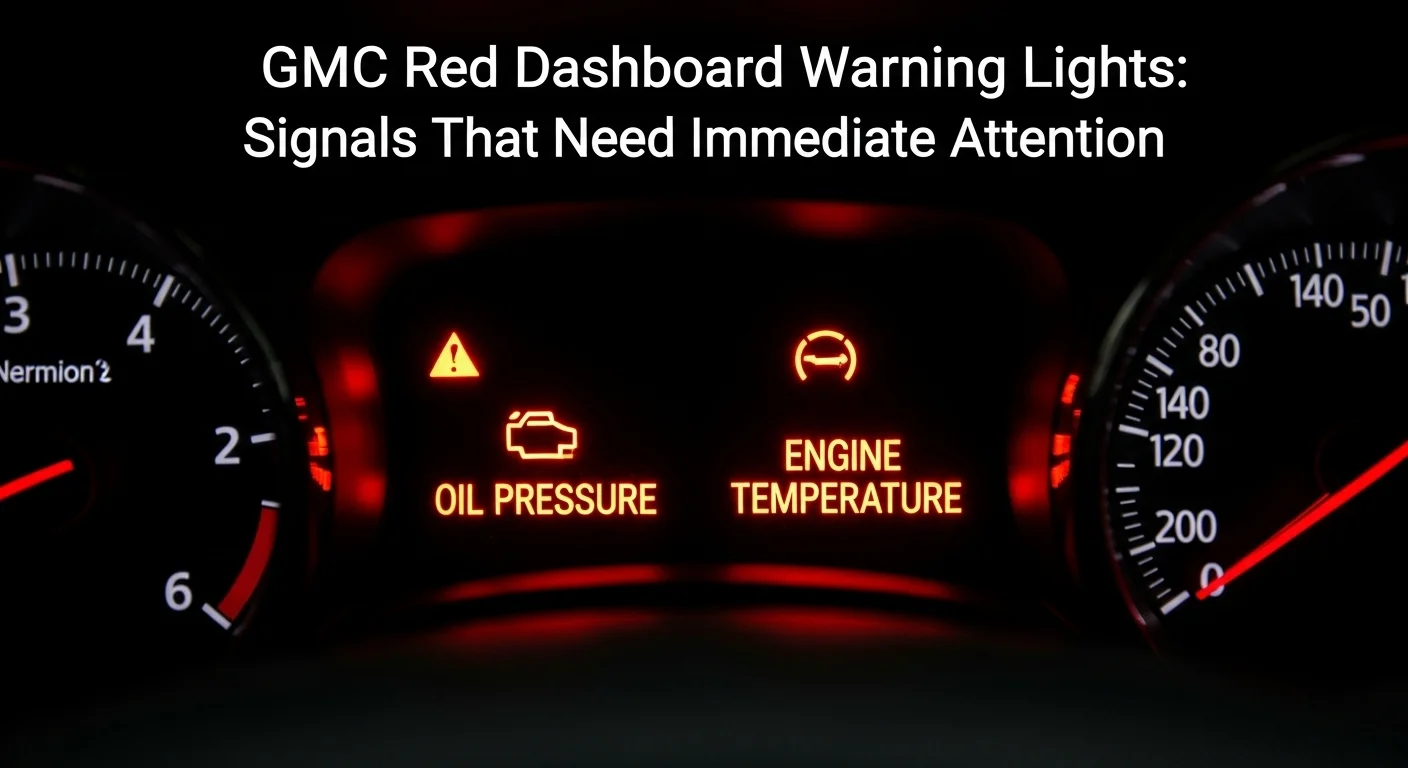
Before we dive deep here’s the basic system GMC uses for warning lights. Red lights mean STOP RIGHT NOW. Something critical is happening. Engine overheating. Brake failure. No oil pressure. Don’t mess around with these at all. Yellow or amber lights mean get it checked soon. Not an emergency but don’t ignore it for weeks. Think check engine light. ABS issues. Traction control problems.

Green or blue lights are just info. These just tell you something’s turned on. High beams. Cruise control. Fog lights. No stress here whatsoever. Pretty straightforward right? Now let’s break down the ones you’ll actually see out there.
The Red Lights That Make Your Heart Stop
1 Brake System Warning Light
What it looks like is a circle with an exclamation mark or sometimes just the word BRAKE. What it means is either your parking brake’s still on which is embarrassing but harmless or you’ve got a real brake problem. Low brake fluid. Failed brake system. Sensor malfunction.
What happened to me once was this guy drove in with the brake light screaming at him for two solid days. Turns out his brake fluid reservoir was completely bone dry. Master cylinder was leaking bad. He’d been driving around with basically no brakes working.
Could’ve killed himself out there. Cost him eight hundred fifty bucks to fix instead of the two hundred it would’ve been if he’d caught it early. What you should do is first check if your parking brake’s released. Yeah we all forget sometimes so don’t feel bad. If it’s released and the light’s still on then pull over safely somewhere. Check brake fluid level under the hood. Clear reservoir on the driver’s side usually.
2 Oil Pressure Warning Light
What it looks like is that old school oil can with a drop coming out of it. What it means is your engine’s not getting enough oil pressure. Could be low oil. Could be a failing oil pump. Could be a clogged filter.Real story here. Customer ignored this light for just ten minutes to get home. Seized his engine completely. Sixteen thousand dollars for a new motor.
Ten minutes of driving. What you should do is pull over immediately. Like RIGHT NOW this second. Turn off the engine completely. Check the oil level with the dipstick. If it’s low add oil but honestly the damage might already be done at that point. If it’s full don’t restart the engine. Call for a tow truck. Your engine can literally destroy itself in under five minutes without oil pressure. Not worth the risk at all.
3 Engine Temperature Warning Hot Coolant
What it looks like is a thermometer sitting in liquid or sometimes just the word TEMP. What it means is your engine’s overheating bad. Coolant’s too hot. Could be low coolant. Thermostat failure. A broken water pump. Or a blown head gasket. My absolute worst call ever was this guy who kept driving with this light on because the heater was still working so he figured it was fine. His head gasket blew on the freeway. Engine filled with coolant. Total loss. Twelve grand for a replacement engine.
What you should do is pull over immediately and shut off the engine. Wait at least thirty minutes for it to cool down. Seriously don’t rush this part. Check coolant level when it’s cool. NEVER when hot because you’ll get burned badly. If it’s low add coolant and water mix. If it keeps overheating get it towed to a shop. Overheating can warp your entire engine block. Once that happens it’s completely game over.
4 Battery Charging System Alert
What it looks like is a little battery symbol with plus and minus signs on it. What it means is your alternator’s not charging the battery anymore. Bad alternator. Loose belt. Or wiring issue somewhere. What’s gonna happen is your battery will drain completely within twenty to thirty minutes of driving. Then you’re dead in the water. What you should do is turn off everything you don’t absolutely need. AC off. Radio off. Heated seats off.
Head straight to a shop or home. Don’t shut off the engine until you’re there because it might not restart at all. Had a customer ignore this on a road trip once. The alternator died in the middle of nowhere Montana. Two hundred dollar tow bill plus the alternator repair. Not fun at all.
The Yellow Lights That Need Attention But Won’t Kill You Today
5 Check Engine Light The Famous One
What it looks like is an engine outline or sometimes the words CHECK ENGINE. What literally everyone asks me is the same thing. Is it serious? My answer is always maybe. Maybe not. Here’s the thing about this light. That light can mean a hundred different problems. From your gas cap’s loose to your catalytic converter’s dying. Common causes I see most often are loose or missing gas cap. Seriously happens ALL the time.

Bad oxygen sensor. Usually costs one hundred fifty to three hundred to fix. Failing catalytic converter. That’s eight hundred to twenty five hundred to fix. Misfiring cylinder. Could be spark plugs or coils or worse. EVAP system leak. That’s emissions stuff.
Steady light versus flashing light matters a lot. Steady means not urgent but get it checked within a week or two. Flashing means serious misfire happening right now. Can damage your catalytic converter fast. Pull over, reduce speed, get to a shop ASAP. What you should do first is make sure your gas cap’s tight. Fixes it thirty percent of the time no joke.
If it stays on get a code scan. AutoZone does it totally free. Google the code and you’ll get an idea what’s actually wrong. Decide if you need immediate service or can wait a bit. I’ve seen people spend twelve hundred bucks on a shop diagnosis when their gas cap was just loose. Check the simple stuff first always.
6 ABS Light Anti Lock Brake System
What it looks like is the letters ABS in a circle. What it means is your anti lock brakes aren’t working right now. Regular brakes still work fine but in a panic stop your wheels might lock up. Real world impact is on dry roads you probably won’t even notice. On ice or wet roads though you could slide instead of stopping controlled.
Common causes are dirty ABS sensor. Easy fix usually fifty to one hundred bucks. Failed wheel speed sensor. One fifty to three hundred. ABS module issue. Five hundred to twelve hundred. What you should do is you can keep driving but be extra careful out there. Schedule service within a few days. Don’t slam on the brakes in bad weather conditions. Not an emergency but don’t let it go for months.
7. Traction Control Stability Control Light
What it looks like is a car with squiggly lines behind it or just the letters TC. What it means is the system that prevents wheel spin isn’t working. Or you accidentally turned it off because there’s usually a button for that. First time I saw this was a customer freaking out that his truck was broken. I reached down, pressed the TC button and it turned off. He’d bumped it with his knee earlier.
We both laughed about it. No charge. What you should do is check if you accidentally turned it off. The button’s usually near the gear shifter. If it’s on and the light won’t go away then get it checked out. Safe to drive just be careful on slippery roads.
8 Tire Pressure Monitoring System TPMS
What it looks like is an exclamation mark inside a tire cross section shape. What it means is one or more tires are low on air. Or the sensor’s acting up. This is THE most common light I see every single day. Especially when seasons change. Temperature drops twenty degrees overnight? This light’s coming on in half the trucks in town.
What you should do is check all four tires with a gauge. Sometimes including the spare. Fill to the recommended PSI. There’s a sticker inside the driver’s door. Drive for a few miles and the light should go off. If it doesn’t then the sensor might be bad. Fifty to eighty bucks to replace usually. Pro tip here. Cold weather makes tires lose one to two PSI for every ten degree drop. Totally normal.
9 Service Vehicle Soon Stabilitrak
What it looks like is a wrench icon or the words SERVICE VEHICLE SOON. What it means is something has detected a minor fault somewhere. Could be a sensor glitch. Emission issue. Or electronic module problem. My experience with this one is it’s super vague. I’ve seen it for everything from a loose gas cap to a failing transmission sensor. What you should do is get a code scan. Free at most auto parts stores. If the truck drives fine it’s not urgent. Schedule service within a week or two.
The Green and Blue Lights Just FYI Stuff
These aren’t warnings at all. They’re just telling you something’s turned on. High Beam Indicator is blue. Your brights are on. Other drivers hate you right now. Cruise Control is green. Cruise is set and active. Fog Lights are green. Fog lights are on.

DRL is green. Daytime running lights are on. Always on for most GMCs. Lane Departure Warning is green or yellow. Varies by model. Green means it’s active. Yellow means you’re drifting out of your lane. Seat Belt Reminder is red. Buckle up. Seriously just do it. Door Ajar is red or yellow. One of your doors isn’t fully closed. Or the sensor’s dirty or broken.
Low Fuel is yellow. You’re running on fumes. Usually about thirty to fifty miles left in the tank. None of these need any action unless they’re telling you something’s actually wrong. Like the door ajar light when all doors are definitely closed. Then it’s a sensor issue.
GMC Model Specific Quirks I Have Noticed
Sierra Issues
The infamous cluster reset bug. Earlier Sierras from 2014 to 2018 had this problem where the entire gauge cluster would reset randomly. All lights flash at once. Then it reboots itself. Not actually dangerous just really annoying. GM issued a software update for it eventually.
Stabilitrak false alarms. I’ve replaced probably fifty Stabilitrak sensors on Sierras over the years. They go bad around eighty to one hundred thousand miles and throw constant warnings even though nothing’s actually wrong.
Terrain Problems
Battery drain issues. Newer Terrains from 2018 forward sometimes have parasitic battery drain. You’ll get the battery light but the alternator’s totally fine. It’s usually a module staying awake and killing the battery overnight. Pain to diagnose honestly. Usually needs a dealer scan tool. False TPMS warnings. Terrain sensors are super sensitive for some reason. I’ve seen them trigger from just two PSI differences. Keep a tire gauge handy always.
Canyon Quirks
Traction control disabled randomly. The Canyon TC button sometimes gets stuck internally. Light stays on. You can’t turn TC back on even after pressing the button repeatedly. Fix? Disconnect the battery for five minutes. Resets the whole system. Works ninety percent of the time.
Denali Specific
More sensors means more problems. Denalis are absolutely loaded with tech. Adaptive cruise. Lane keep assist. Blind spot monitors. All those sensors? They all have their own warning lights. And they all can fail. I see way more false positive warnings on Denalis than any other GMC model. A dirty camera will throw three different alerts at once.
How to Actually Reset These Lights What Works What Doesn’t
Method 1 Fix the actual problem
Duh right? But seriously most lights don’t just reset on their own. You have to actually fix what triggered them. Low tire pressure? Fill the tire. The light goes off after driving a few miles. Loose gas cap? Tighten it properly. The light goes off after two to three drive cycles.
Method 2 Disconnect the battery
Unhook the negative terminal for ten minutes. This clears stored codes and resets the computer. Warning though. This also resets your radio presets, clock and learned driving patterns. Your truck might run a little rough for a few days while it relearns everything.
Method 3 OBD II scanner
You can buy one for twenty five bucks on Amazon. Plug it into the port under your steering wheel. Read the codes. Clear them if you want. But here’s the catch. If the problem’s still there the light comes right back on. Sometimes within literal seconds. I’ve watched people clear a check engine light six times in one day because they wouldn’t actually fix the problem.
Method 4 Take it to a shop
Honestly? If you’re not sure what’s wrong just take it in. A good shop will scan for codes. Often free. Tell you exactly what’s wrong. Give you a quote. Reset the light after fixing it properly. Don’t throw parts at a problem hoping it goes away. I’ve seen people spend eight hundred dollars on parts that didn’t fix anything because they were just guessing.
The Why Are ALL My Lights On Scenario
Every few months someone brings me a GMC that looks like a Christmas tree. Every single warning light is lit up at once. Common causes are bad alternator or battery. When electrical power drops all the modules freak out and throw errors everywhere. Fix the charging system and lights go away.
Corroded ground connections. GMCs have several ground points under the truck. They corrode especially in salt states. Clean the grounds and problem solved. ECM or BCM failure. The computer itself crashes. Usually needs to be reflashed or replaced completely. Dealer job.
Rodent damage. Yeah I said it. Mice absolutely love to nest in engine bays and chew wiring. I’ve found full nests with destroyed harnesses. Causes all kinds of random errors. If every light comes on at once it’s almost never everything’s broken at the same time. It’s usually one electrical problem causing a cascade failure.
What Maintenance Prevents These Lights
Look I’m not gonna pretend regular maintenance stops every warning light. Sometimes stuff just breaks randomly. But here’s what actually helps prevent problems. Oil changes every five thousand miles. Prevents oil pressure light and reduces engine wear. Coolant flushes every hundred thousand miles. Stops overheating issues and corrosion buildup.
Tire rotations every seventy five hundred miles. Even wear means fewer TPMS alerts. Battery replacement every four to five years. Prevents charging system errors and voltage drops. Brake fluid flush every three years. Keeps the brake system happy and prevents ABS issues. Air filter replacement yearly. Helps prevent check engine lights from MAF sensor contamination.
Software updates at the dealer. Seriously. They fix bugs that cause false warnings. The last one surprises people a lot. GMC issues software updates constantly. Some fix actual bugs in the warning light system itself. I had a customer with a persistent Stabilitrak warning. Nothing wrong mechanically at all. Took it to the dealer, they updated the software, problem gone completely. Twenty minutes. No parts needed.
My Personal Checklist When a Light Pops Up
Here’s what I do every single time and what you should do too. Step 1 is note the color immediately. Red? Pull over now. Yellow? Finish your drive but address it soon. Green or blue? Just info, no action needed. Step 2 is check the simple stuff first. Gas cap tight? Parking brake released? Doors fully closed?
Tire pressure okay? You’d be absolutely shocked at how many problems are just human error. Step 3 is how’s the truck actually driving? If it’s running fine, sounds normal, brakes work, temperature’s good then probably not critical. Still needs attention but not an emergency.
If it’s running rough, overheating, making weird noises then yeah get it checked NOW. Step 4 is get it scanned somewhere. Most auto parts stores scan codes totally free. Takes five minutes. Gives you actual information instead of guessing wildly.
Step 5 is research the code online. Google is your friend here. Type in the code like P0420 or C0045 plus GMC Sierra and you’ll find forums full of people who had the exact same problem. Step 6 is decide if you can DIY or need a pro. If it’s simple stuff like air filter, gas cap, tire pressure then do it yourself. If it’s complex like transmission, engine internals, ABS module then take it to someone who knows what they’re doing.
When to Go to the Dealer vs Independent Shop
Go to the dealer when you’re still under warranty. Obviously. It’s a recall issue. Free fix. You need software updates. It’s a complex electronic problem. You want official service records for resale value. Go to an independent shop when you’re out of warranty.
It’s routine stuff like brakes, oil changes, tires. You want better prices. You have a trusted mechanic already. Dealers charge one fifty to two hundred per hour for labor. Good independent shops? Usually ninety to one twenty per hour. For routine stuff I always recommend independent. For weird electronic gremlins sometimes the dealer’s the only real option.
Real Questions I Get Asked Weekly
Can I just put tape over the light? No. I mean you CAN but that’s completely idiotic. The light’s there for a reason. Ignoring it doesn’t make the problem go away at all. Plus if it’s something serious you could be stranded. Or worse. Will it pass inspection with a check engine light on?
Nope. Automatic fail in most states. You have to fix whatever’s triggering the light and get it to turn off before inspection. My buddy has a scanner tool. Can he just turn it off? He can clear the code temporarily. But if the problem’s still there it’ll come right back. Sometimes within minutes.
You’re not outsmarting the computer. Fix the actual issue. How much does a diagnostic cost? Free to one fifty depending on where you go. AutoZone, O’Reilly, Advance Auto do free code scans but they can’t do deep diagnostics. Independent shop usually seventy five to one hundred for a full diagnostic.
Dealer is one hundred to one fifty but they have better tools and factory information. Is it safe to drive with the check engine light on? If it’s steady not flashing and the truck drives normally? Yeah you can drive it to get it checked out. If it’s flashing? No. Pull over immediately.
My lights keep coming on and off randomly. That’s usually electrical issues. Bad ground connection. Failing alternator. Or corroded wiring somewhere. Don’t ignore intermittent warnings. They usually get worse over time.
The Dashboard Lights You’ll Probably Never See But Should Know Exist
Electronic Throttle Control Warning. Your drive by wire throttle has an issue. The truck might go into limp mode with reduced power. Diesel Exhaust Fluid DEF Warning. For diesel Sierras. DEF is low. Fill it or the truck won’t start eventually. Four Wheel Drive System Fault. Transfer case or 4WD electronics have a problem. Usually on Sierras and Denalis.
Adaptive Cruise Control Disabled. Sensor’s blocked or failed. Common in winter when the front camera gets covered in salt and snow. Collision Alert. Forward collision system detected an issue. Could be just a dirty sensor. Most of these are pretty rare. But when they pop up at least you’ll know what you’re looking at.
My Final Take on GMC Warning Lights
Here’s the bottom line on all this. Your dashboard lights aren’t there to annoy you. They’re there to save your ass from expensive repairs. Red light? Take it seriously every time. Pull over. Check it out. Don’t gamble with your engine. Yellow light? Don’t panic but don’t ignore it for three months either. Green light? Just information. Nothing to stress about.
The biggest mistake I see constantly? People ignoring lights because the truck seems fine right now. Yeah it seems fine NOW. But that check engine light is warning you about something that WILL get worse. That oil pressure light gives you maybe five minutes before your engine seizes completely.
That temperature light gives you maybe ten minutes before you warp the block permanently. Pay attention to these things. Be smart about it. And when in doubt just get it checked professionally. Your GMC’s built tough but it’s definitely not indestructible. Take care of it properly and it’ll take care of you for two hundred thousand plus miles. Ignore the warning lights and you’re shopping for a new truck at eighty thousand miles. Your call entirely.
FAQ
What does a red warning light mean on my GMC?
Red lights mean stop immediately. Something critical is happening like engine overheating, brake failure or no oil pressure. Pull over safely and address it right away before you damage something expensive.
Can I drive with the check engine light on?
If it’s steady and the truck drives normally you can drive to get it checked. If it’s flashing pull over immediately because that means serious misfire that can damage the catalytic converter.
Why are all my dashboard lights on at once?
Usually electrical issues. Bad alternator or battery causing voltage drops. Corroded ground connections. Or computer module failure. Rarely means everything’s actually broken at the same time.
How do I reset my GMC dashboard lights?
Fix the actual problem first. Then the light goes off on its own. You can disconnect the battery for ten minutes to clear codes but the light comes back if the problem still exists.
What does the TPMS light mean?
Tire Pressure Monitoring System detected low air in one or more tires. Check all tires with a gauge and fill to recommended PSI listed on driver door sticker. Light goes off after driving a few miles.